The Business Research Company’s Anti-Cancer MABs Global Market Report 2026 – Market Size, Trends, And Forecast 2026-2035
LONDON, GREATER LONDON, UNITED KINGDOM, October 27, 2026 /EINPresswire.com/ — The landscape of cancer treatment is rapidly evolving, with monoclonal antibodies (MABs) playing a pivotal role in transforming therapeutic approaches. As a specialized segment of targeted therapies, anti-cancer MABs are gaining substantial market traction and are set to become a cornerstone in oncology care. Below, we explore the market size, regional dominance, key growth drivers, and competitive landscape shaping this dynamic industry.
Market Size and Projection for Anti-Cancer MABs
The anti-cancer monoclonal antibodies market is on track to exceed $112 billion by 2030. This segment is part of the larger targeted therapy market, which is projected to reach around $157 billion in the same year. Notably, anti-cancer MABs will make up roughly 71% of the targeted therapy sector. Within the vast pharmaceuticals industry, expected to hit $2,496 billion by 2030, the anti-cancer MABs market is estimated to represent close to 4% of the total value.
Request A Free Sample Of The Anti-Cancer MABs Market Report
https://thebusinessresearchcompany.com/sample_request?id=31678655&type=smp&name=Anti-Cancer%20MAbS%20Market%20Report%202026&utm_source=EINPresswire&utm_medium=Paid&utm_campaign=Oct_PR
North America’s Leading Role in the Anti-Cancer MABs Market by 2030
North America is set to remain the dominant region in the anti-cancer MABs market, with a projected valuation of $42 billion in 2030. The market is expected to rise from $28 billion in 2025 at a compound annual growth rate (CAGR) of 9%. Several factors contribute to this growth, including widespread adoption of targeted biologic therapies, increasing cancer incidence, broader reimbursement policies for monoclonal antibody treatments, vigorous clinical research on next-generation oncology biologics, significant investments in biomanufacturing, and a well-established infrastructure that supports advanced cancer therapies.
The United States as the Largest Anti-Cancer MABs Market Country
The United States will hold the top position globally, with the market anticipated to reach $40 billion by 2030, growing from $25 billion in 2025 at a 10% CAGR. This expansion is fueled by the rising number of approvals for novel monoclonal antibody drugs addressing various cancers, increased use of precision medicine in oncology, substantial healthcare spending enabling access to cutting-edge biologics, integration of biomarker-guided therapies into clinical practice, a strong presence of leading biotech and pharma companies, and continuous advancements in immuno-oncology research and development.
Access The Detailed Anti-Cancer MABs Market Report Here
https://thebusinessresearchcompany.com/report/anti-cancer-MAbS-global-market-report?utm_source=EINPresswire&utm_medium=Paid&utm_campaign=Oct_PR
Dominant Product Segment in the Anti-Cancer MABs Market
Breaking down the market by antibody type reveals that humanized antibodies will be the largest segment, accounting for 40%, or $45 billion, of the market in 2030. Their prominence is linked to their lower immunogenicity compared to earlier formats, growing clinical preference for therapies offering better safety and effectiveness, a rising portfolio of approved humanized antibody therapies for major cancers, increasing use in combination treatments, strong investment in antibody engineering, and an active pipeline focused on highly specific targeted oncology drugs.
Applications and End-User Segments in the Market
The anti-cancer MABs market is diversified by cancer types, including blood cancer, breast cancer, lung cancer, melanoma, colorectal cancer, liver cancer, and others. On the end-user side, the market serves hospitals, research institutes, and various other healthcare providers.
Expected Growth Rate Leading to 2030
The overall anti-cancer MABs market is forecasted to expand at a CAGR of 9% through 2030, reflecting steady and robust growth driven by multiple factors.
Key Factors Fueling Market Expansion
Rising Incidence of Cancer Worldwide
One of the primary forces driving market growth is the increasing global incidence of cancer. As cancer rates climb in both developed and emerging nations, the demand for targeted treatment options rises accordingly. Factors such as aging populations, lifestyle influences, and better diagnostic capabilities are contributing to a larger pool of patients who require advanced therapies. Monoclonal antibodies are favored for their ability to selectively attack cancer cells while sparing healthy tissue, resulting in a sustained need for innovative oncology biologics. This trend is expected to add approximately 2.7% to the annual market growth.
Growing Investment in Oncology Research and Development
Another major growth driver is the expanding investment in oncology research and development. Pharmaceutical and biotech firms are dedicating significant resources to developing next-generation antibody therapies with improved efficacy and broader applications. The rise in clinical trials, advancements in antibody engineering, and exploration of combination therapies are accelerating product pipelines. Academic and research institutions are also collaborating intensively to push forward novel treatments. This increased R&D focus is predicted to contribute around 2.4% to the market’s yearly growth.
Clinical Success of Humanized and Fully-Human MABs Enhances Adoption
The proven effectiveness of humanized and fully-human monoclonal antibodies in multiple cancer types continues to boost physician confidence and patient uptake. These antibody formats offer enhanced targeting, better tolerability, and versatility in precision oncology, encouraging expanded use across various treatment lines. The growing body of clinical evidence supporting their long-term benefits is expected to drive about 2.1% in annual market growth.
Emerging Growth Opportunities Across Antibody Types
Key growth prospects are seen across the murine, chimeric, humanized, and other antibody segments. Together, these markets are projected to contribute over $40 billion in value by 2030. This expansion is propelled by increased adoption of precision oncology, wider availability of biomarker-guided therapies, commercialization of advanced antibody platforms, growing demand for highly specific cancer treatments, and ongoing innovations in antibody design and manufacturing. The healthcare industry’s focus on improved treatment outcomes and broader access to next-generation biologics underpins this robust momentum.
Projected Market Growth by Antibody Type from 2025 to 2030
Over the next five years, the humanized antibodies segment is expected to grow by $16 billion, other antibody types by $13 billion, chimeric antibodies by $7 billion, and murine antibodies by $4 billion. The market features a blend of global biopharma giants and specialized oncology biotech firms emphasizing next-generation antibody engineering, immuno-oncology portfolio expansion, bispecific and antibody-drug conjugate platforms, biomarker-driven treatments, and manufacturing advancements to capture emerging opportunities. Priorities such as therapeutic efficacy, patient safety, regulatory approvals, and market expansion into underserved cancer areas remain central to competitive strategies.
Leading Company Driving the Anti-Cancer MABs Market
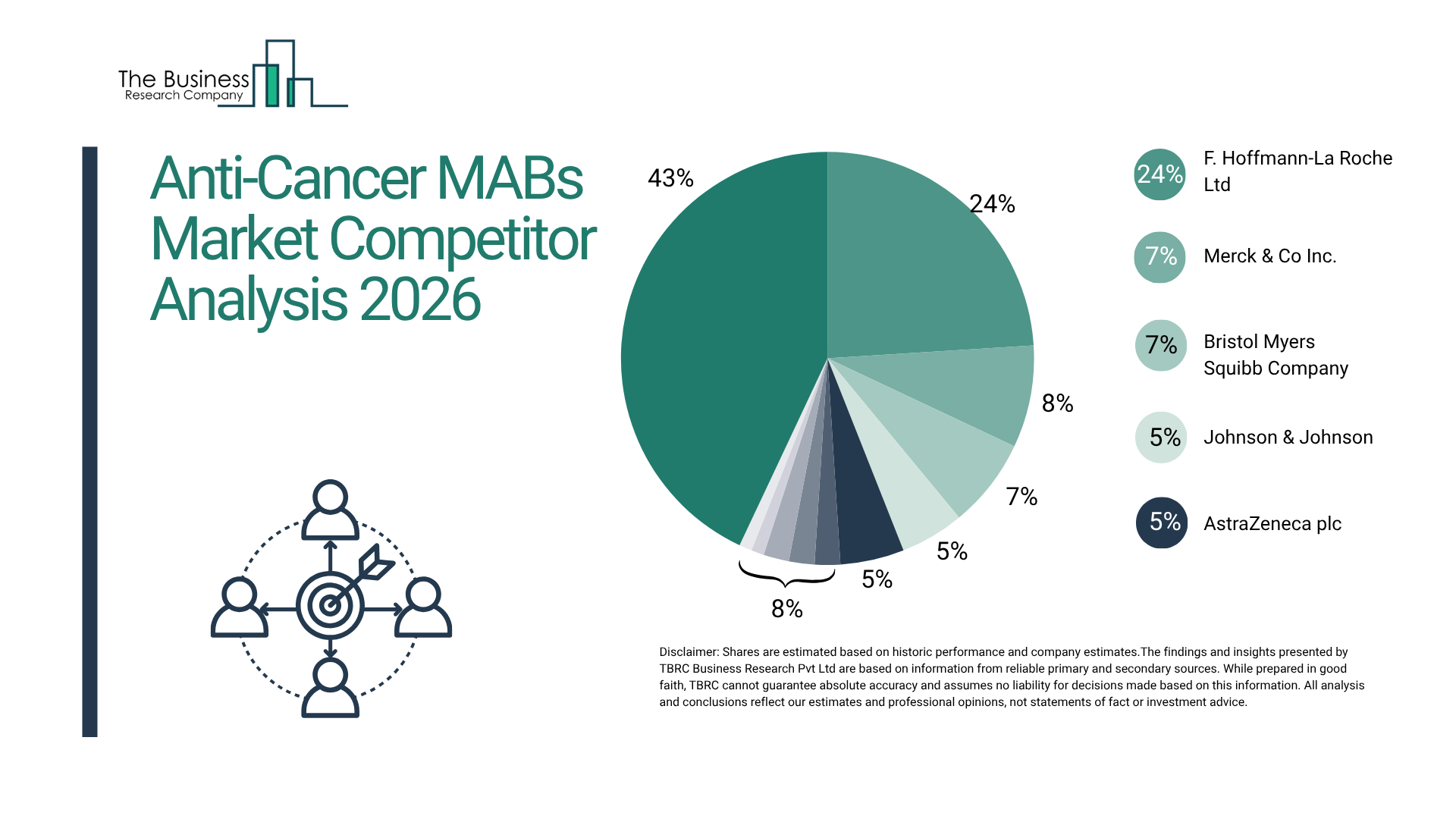
In 2025, F. Hoffmann-La Roche Ltd led the global anti-cancer MABs market with a 24% share. Roche’s oncology portfolio comprises a wide range of monoclonal antibody therapies targeting both hematologic and solid tumors, supporting precision oncology, immune-mediated treatments, comprehensive disease management, and improved patient outcomes worldwide.
Top Industry Players Operating in the Market
The market includes major firms such as F. Hoffmann-La Roche Ltd, Merck & Co. Inc., Bristol Myers Squibb Company, Johnson & Johnson, AstraZeneca plc, AbbVie Inc., Novartis AG, Amgen Inc., Eli Lilly and Company, Pfizer Inc., Regeneron Pharmaceuticals, BeOne Medicines, Daiichi Sankyo, GlaxoSmithKline plc, Takeda Pharmaceuticals, Innovent Biologics Inc., Bayer HealthCare, Ipsen SA, ADC Therapeutics, MacroGenics Inc., Zymeworks Inc., and Gilead Sciences Inc.
Market Concentration and Competitive Dynamics
The anti-cancer MABs market is highly concentrated, with the top 10 companies responsible for 57% of total revenue in 2025. This concentration stems from significant scientific, regulatory, and commercialization challenges, including complex biologics development, stringent clinical trial and approval requirements, intellectual property protection, and large-scale manufacturing demands. Leading players like Roche, Merck, Bristol Myers Squibb, Johnson & Johnson, AstraZeneca, AbbVie, Novartis, Amgen, Eli Lilly, and Pfizer maintain strong positions through extensive oncology portfolios, robust development pipelines, global sales networks, and continuous innovation in antibody technologies. As demand for targeted therapies, personalized medicine, immunotherapies, and combination treatments grows, these companies are expected to strengthen their leadership through pipeline expansion, strategic alliances, and cutting-edge antibody engineering.
Key Raw Material Providers Supporting the Market
Important suppliers of raw materials in the anti-cancer MABs space include Thermo Fisher Scientific Inc., Danaher Corporation, Sartorius AG, Merck KGaA, Cytiva, Lonza Group AG, FUJIFILM Irvine Scientific, Repligen Corporation, Avantor Inc., Corning Incorporated, Eppendorf SE, Bio-Rad Laboratories Inc., AGC Biologics, Asahi Kasei Corporation, Wacker Chemie AG, Solventum Corporation, Purolite Corporation, JSR Life Sciences, Tosoh Corporation, and Novasep Holding SAS.
Major Wholesalers and Distributors in the Market
Key distributors serving the anti-cancer MABs industry comprise Cencora Inc., McKesson Corporation, Cardinal Health Inc., Morris & Dickson Co. LLC, FFF Enterprises Inc., Anda Inc., H. D. Smith LLC, Oncology Supply, Dakota Drug Inc., Smith Drug Company, Medline Industries LP, Zuellig Pharma Holdings Ltd., DKSH Holding Ltd., Imperial Dade Healthcare Solutions, Pharma Logistics LLC, Movianto Group, Alliance Healthcare, Phoenix Pharmahandel GmbH & Co. KG, Sinopharm Group Co. Ltd., and Shanghai Pharma Corporation.
Prominent End Users of Anti-Cancer MABs
Leading institutions utilizing anti-cancer MABs include MD Anderson Cancer Center, Memorial Sloan Kettering Cancer Center, Mayo Clinic, Cleveland Clinic, Dana-Farber Cancer Institute, The Royal Marsden NHS Foundation Trust, Institut Gustave Roussy, National Cancer Center Hospital, Apollo Hospitals Enterprise Ltd., Tata Memorial Centre, Fortis Healthcare Ltd., Max Healthcare Institute Ltd., HCA Healthcare Inc., University Health Network, National University Cancer Institute Singapore, Peter MacCallum Cancer Centre, Samsung Medical Center, and Asan Medical Center.
Competitive Trends Shaping the Market
Strategic partnerships in oncology are accelerating the development of advanced antibody therapies, expanding global commercialization, and fostering innovation in treating solid tumors. For instance, in October 2025, Takeda Pharmaceuticals formed a global alliance with Innovent Biologics Inc. to co-develop and commercialize IBI363, a late-stage bispecific PD-1/IL-2α antibody fusion protein, alongside other oncology antibody treatments. This collaboration leverages bispecific antibody technology, a global co-development framework, and substantial investment to improve access to novel immuno-oncology therapies and speed up clinical development across multiple solid tumor indications.
Strategies Companies Employ to Maintain Market Leadership
Leading companies are focusing on advancing bispecific antibody platforms to improve targeted cancer therapies, expanding precision oncology via biomarker-guided treatments, increasing the use of antibody-drug conjugates for solid tumors, forging strategic collaborations to boost biologics development, and innovating manufacturing processes to enhance monoclonal antibody production efficiency. These approaches are designed to keep pace with evolving cancer treatment needs and sustain competitive advantage within the anti-cancer MABs market.
Key enhancements in our 2026 market reports include:
• Market attractiveness scoring and analysis
• Total addressable market (TAM) analysis
• Company scoring matrix graphics and tables
• Excel-based forecasting dashboards
• Market hotspots infographics
• Key technologies and future trend analysis
• Updated graphics and tables
Learn More About The Business Research Company
The Business Research Company (www.thebusinessresearchcompany.com) is a leading market intelligence firm renowned for its expertise in company, market, and consumer research. We have published over 30,000+ reports across 27 industries and 60+ geographies. Our research is powered by 1,500,000 datasets, extensive secondary research, and exclusive insights from interviews with industry leaders.
We provide continuous and custom research services, offering a range of specialized packages tailored to your needs, including Market Entry Research Package, Competitor Tracking Package, Supplier & Distributor Package and much more.
Disclaimer: Please note that the findings, conclusions and recommendations that TBRC Business Research Pvt Ltd delivers are based on information gathered in good faith from both primary and secondary sources, whose accuracy we are not always in a position to guarantee. As such TBRC Business Research Pvt Ltd can accept no liability whatever for actions taken based on any information that may subsequently prove to be incorrect. Analysis and findings included in TBRC reports and presentations are our estimates, opinions and are not intended as statements of fact or investment guidance.
Contact Us:
The Business Research Company
Americas +1 310-496-7795
Europe +44 7882 955267
Asia & Others +44 7882 955267 & +91 8897263534
Email: marketing@tbrc.info
Follow Us On:
LinkedIn: https://in.linkedin.com/company/the-business-research-company
Oliver Guirdham
The Business Research Company
+44 7882 955267
info@tbrc.info
Visit us on social media:
LinkedIn
Facebook
X
Legal Disclaimer:
EIN Presswire provides this news content “as is” without warranty of any kind. We do not accept any responsibility or liability
for the accuracy, content, images, videos, licenses, completeness, legality, or reliability of the information contained in this
article. If you have any complaints or copyright issues related to this article, kindly contact the author above.

Media gallery