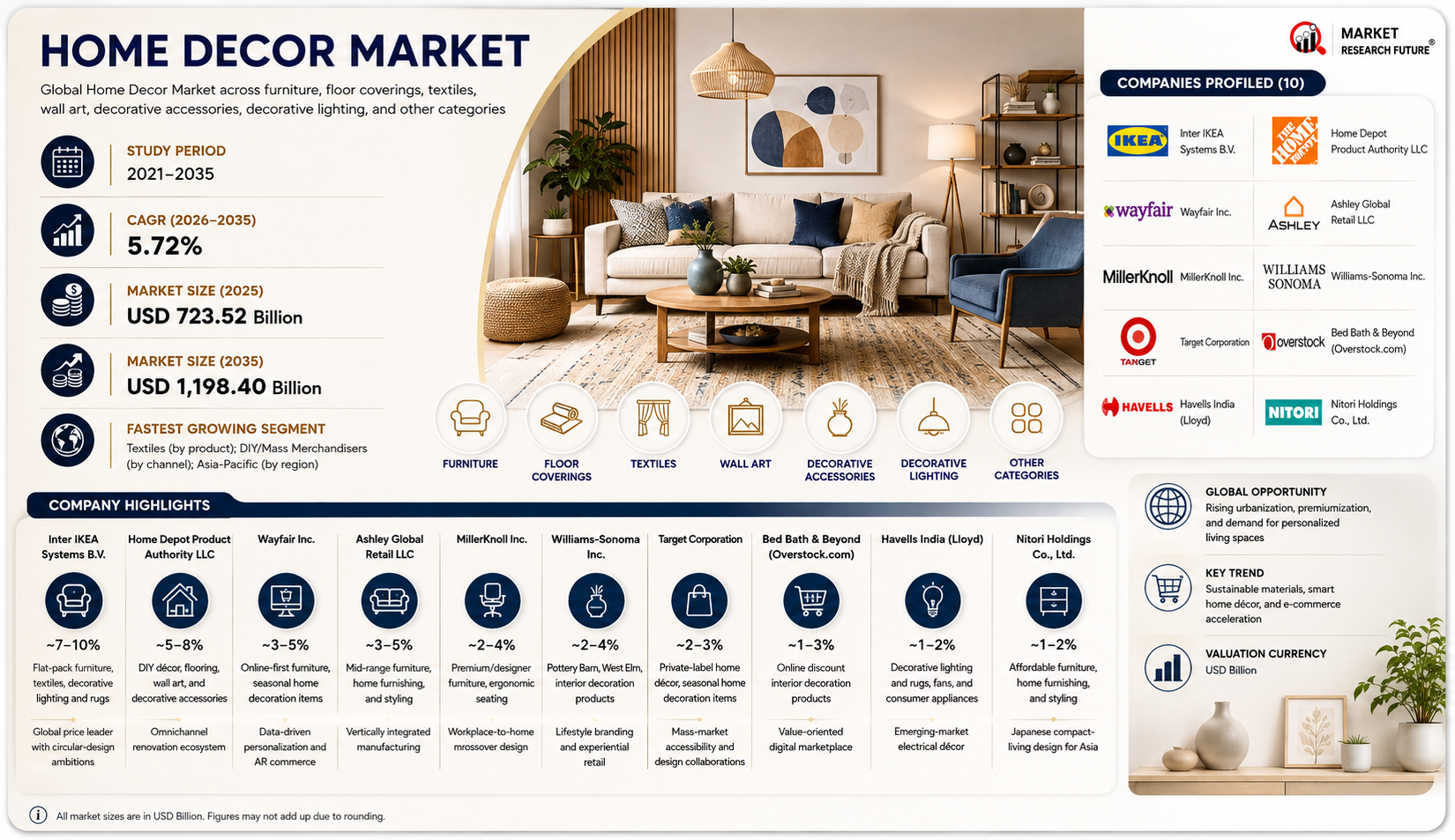
The Home Decor Market is projected to reach USD 1,198.40 billion by 2035, driven by design-led living, textiles, DIY retail, and Asia-Pacific growth.
NEW YORK, NY, UNITED STATES, August 24, 2026 /EINPresswire.com/ —
The global Home Decor Market is entering a period of sustained expansion as consumers increasingly view residential spaces as extensions of personal identity, lifestyle, comfort, and functionality. The market, covering furniture, floor coverings, textiles, wall art, decorative accessories, decorative lighting, and other home styling products, is projected to grow from USD 723.52 billion in 2025 to USD 1,198.40 billion by 2035, registering a 5.72% CAGR from 2026 to 2035. Rising household formation, urbanization, renovation activity, changing interior preferences, and the growing influence of digital inspiration are reshaping purchasing behavior across developed and emerging economies.
The competitive landscape combines global furniture groups, home-improvement retailers, digital marketplaces, lifestyle brands, and electrical-decoration manufacturers. Key players include Inter IKEA Systems B.V., Home Depot Product Authority LLC, Wayfair Inc., Ashley Global Retail LLC, MillerKnoll Inc., Williams-Sonoma Inc., Target Corporation, Bed Bath & Beyond (Overstock.com), Havells India (Lloyd), and Nitori Holdings Co., Ltd. Their strategies range from low-cost modular furniture and omnichannel retailing to premium design, digital personalization, vertically integrated manufacturing, and compact-living solutions. Estimated revenue-share ranges indicate a fragmented but competitive structure, with Inter IKEA holding approximately 7–10%, Home Depot 5–8%, Wayfair and Ashley Global Retail around 3–5% each, and other major participants occupying smaller portions.
Free Sample Copy – Access A Complimentary Copy of Our Report to Explore Its Content and Insights
https://www.marketresearchfuture.com/sample_request/11525
Market Drivers Shaping Home Decor Demand
One of the strongest growth drivers is the increasing emphasis on home personalization. Consumers are moving beyond purely functional purchases and looking for coordinated interiors that reflect individual preferences. Social media platforms, interior-design content, virtual room inspiration, and online product discovery have shortened the distance between professional design trends and everyday consumers. This trend supports demand for decorative accessories, wall art, lighting, textiles, rugs, and complementary furniture pieces.
Another important factor is the expansion of home renovation and refurbishment activity. Existing homeowners are increasingly upgrading individual rooms rather than undertaking complete property replacements. Kitchens, bedrooms, living rooms, home offices, and outdoor spaces are becoming targets for periodic redesign. The availability of affordable decorative products allows consumers to refresh interiors without major structural changes, supporting recurring demand across multiple product categories.
Urbanization is also influencing the composition of home décor purchases. Smaller urban residences require products that combine aesthetics with efficient space utilization. Modular furniture, multifunctional storage, compact seating, adaptable lighting, and lightweight decorative products are therefore gaining relevance. In parallel, consumers in larger homes continue to seek premium furnishings and statement décor, creating opportunities across both value-oriented and premium segments.
Product Segment Analysis
Furniture remains a foundational component of the Home Decor Market, encompassing seating, tables, beds, storage, cabinets, and complementary furnishings. Demand is increasingly shaped by modularity, multifunctionality, ergonomic design, and space efficiency. Consumers are also showing greater interest in furniture that can transition between work, relaxation, and social environments.
Textiles represent the fastest-growing product segment. Curtains, cushions, bedding, upholstery, throws, rugs, and other textile products enable consumers to change interior aesthetics relatively quickly and at comparatively lower costs than replacing major furniture. Seasonal trends, color preferences, tactile materials, sustainability considerations, and frequent home refresh cycles are supporting this category.
Floor coverings include carpets, rugs, mats, and related products that contribute to both visual appeal and comfort. Rugs are particularly important in contemporary interiors because they can define zones within open-plan rooms and provide an affordable method of introducing patterns, colors, and textures.
Wall art is benefiting from personalization and digital commerce. Framed artwork, prints, mirrors, decorative panels, and other wall treatments allow consumers to create focal points without extensive renovation. Online visualization tools are also helping shoppers assess how products may fit within existing interiors.
Decorative accessories encompass vases, ornaments, candles, clocks, sculptures, storage décor, and other styling elements. These products encourage repeat purchases because consumers can introduce incremental changes to their interiors without replacing larger furnishings.
Decorative lighting is increasingly positioned as both a functional and aesthetic component. Pendant fixtures, table lamps, floor lamps, accent lighting, and smart-enabled solutions can influence the atmosphere and perceived design quality of residential spaces. Energy efficiency and connected-home compatibility are additional considerations affecting product selection.
Channel Analysis: DIY/Mass Merchandisers Lead Growth
The DIY/Mass Merchandisers segment is expected to be the fastest-growing channel as consumers seek convenience, affordability, and immediate access to home-improvement products. Large-format retailers can combine décor with flooring, renovation supplies, furniture, lighting, and seasonal merchandise, encouraging cross-category purchasing.
Specialty stores remain important because they provide focused product assortments and opportunities for consumers to evaluate materials, finishes, and designs physically. Meanwhile, online channels continue to transform the buying journey through extensive product catalogs, reviews, recommendation engines, augmented-reality visualization, and home-delivery services.
Wayfair illustrates the importance of digital-first retail, while companies such as Home Depot and Target demonstrate how physical stores can be integrated with online discovery and fulfillment. This convergence between physical and digital commerce is likely to remain a defining characteristic of the market through 2035.
Regional Analysis: Asia-Pacific Emerges as a High-Growth Market
Asia-Pacific is projected to be the fastest-growing regional market. Rapid urbanization, rising household incomes, expanding middle-class populations, residential construction, and changing lifestyle preferences are increasing spending on home furnishing and decoration. Consumers across Asian markets are also increasingly exposed to international interior-design trends while maintaining preferences for regionally appropriate layouts and materials.
Japan offers a distinct example through compact-living design, multifunctional furniture, and efficient storage solutions. Nitori Holdings has established a strong positioning around accessible home furnishing and Japanese space-conscious design. India and other developing Asian markets provide additional opportunities as residential development and discretionary spending expand.
North America remains an important market supported by renovation expenditure, established retail networks, and high consumer adoption of online home-shopping platforms. Europe continues to emphasize design quality, sustainability, energy efficiency, and durable products, while other emerging regions offer longer-term opportunities linked to urban development and rising purchasing power.
Proceed To Buy – Move Forward with Your Purchase and Gain Instant Access to the Complete Report
https://www.marketresearchfuture.com/checkout?currency=one_user-USD&report_id=11525
Competitive Landscape and Strategic Positioning
Competition is increasingly based on a combination of price, design, assortment, convenience, brand identity, digital experience, and supply-chain efficiency. Inter IKEA maintains a broad global position through flat-pack furniture, textiles, rugs, and decorative lighting, supported by cost efficiency and scalable design. Home Depot emphasizes an omnichannel renovation ecosystem, while Wayfair focuses heavily on digital discovery, personalization, and technology-enabled shopping.
Ashley Global Retail benefits from vertically integrated manufacturing and a strong mid-range furnishing position. MillerKnoll brings premium and designer-oriented capabilities, including ergonomic furniture that can address the growing overlap between workplace and residential environments. Williams-Sonoma uses lifestyle-oriented brands such as Pottery Barn and West Elm to compete through curated design and experiential retail.
Target competes through accessible private-label décor, seasonal collections, and design collaborations. Overstock.com focuses on value-oriented digital merchandising, while Havells India extends its positioning into decorative lighting and related home products. Nitori Holdings emphasizes affordable furnishing and compact-living solutions, particularly relevant to Asian urban households.
Outlook Through 2035
The Home Decor Market is expected to remain supported by the convergence of interior personalization, digital commerce, renovation, urbanization, multifunctional living, and evolving consumer expectations. Sustainability is also becoming more relevant as consumers and manufacturers consider recyclable materials, durable products, responsible sourcing, repairability, and circular design principles.
The market’s projected expansion to USD 1,198.40 billion by 2035 demonstrates the scale of opportunity across both established and emerging categories. Textiles are positioned for particularly strong product-level growth, while DIY/mass merchandisers are expected to benefit from their combination of convenience and broad assortment. At the regional level, Asia-Pacific stands out for its growth potential as residential development and lifestyle modernization continue.
Frequently Asked Questions
1. What is the projected size of the Home Decor Market by 2035?
The global Home Decor Market is projected to reach USD 1,198.40 billion by 2035, growing at a 5.72% CAGR between 2026 and 2035 from USD 723.52 billion in 2025.
2. Which segment is expected to grow fastest in the Home Decor Market?
Textiles are expected to be the fastest-growing product segment, while DIY/Mass Merchandisers lead by channel and Asia-Pacific represents the fastest-growing regional market.
Key Takeaway
The Home Decor Market is evolving from occasional furnishing purchases toward a broader, recurring ecosystem of lifestyle, personalization, renovation, and functional design. Companies that combine competitive pricing with differentiated design, omnichannel accessibility, digital engagement, and efficient supply chains are positioned to compete effectively as consumer expectations continue to change through 2035.
Read Our Related Research Report
Online On Demand Home Services Market –
https://www.marketresearchfuture.com/reports/online-on-demand-home-services-market-25191
Home Textile Market –
https://www.marketresearchfuture.com/reports/home-textile-market-12292
Home Improvement Market –
https://www.marketresearchfuture.com/reports/home-improvement-market-20673
Home Decontamination Service Market –
https://www.marketresearchfuture.com/reports/home-decontamination-service-market-33391
Home Appliances Market –
https://www.marketresearchfuture.com/reports/major-home-appliances-market-27211
Sagar Kadam
Market Research Future
+1 628-258-0071
email us here
Legal Disclaimer:
EIN Presswire provides this news content “as is” without warranty of any kind. We do not accept any responsibility or liability
for the accuracy, content, images, videos, licenses, completeness, legality, or reliability of the information contained in this
article. If you have any complaints or copyright issues related to this article, kindly contact the author above.

Media gallery