
Key Takeaways
- The golf industry loses over $5.65 billion in F&B revenue annually, according to the ClubGrub Report, driven by missed service moments, golfers self-supplying, and on-course food waste.
- The biggest revenue problem is the gap between when a golfer wants a drink and when – or whether – they actually get one.
- Next-generation golfers expect on-demand convenience, and traditional beverage cart models are falling short of that expectation.
- DrinkCartPing is a golf course ordering tool that closes the handoff gap between golfer and cart using a QR-based, no-app request system – worth a closer look for any course leaving cart revenue on the table.
- Closing even a fraction of missed service moments can meaningfully shift a course’s F&B numbers – read on for what that gap actually looks like in dollars.
Most golf course operators know their beverage cart could be doing more. What’s harder to see is exactly how much revenue walks off the course every single day – not because golfers didn’t want to spend, but because the cart wasn’t there at the right moment.
Golf Courses Are Leaving Billions in F&B Revenue on the Table
The ClubGrub Report places total annual F&B losses for the golf industry at over $5.65 billion. That figure accounts for missed service opportunities, golfers self-supplying from coolers they packed themselves, and on-course food waste. This is not revenue that disappeared because demand wasn’t there – it disappeared because the system wasn’t set up to capture it.
For course operators and clubhouse managers trying to grow non-green-fee income, that number should feel both alarming and motivating, because a meaningful slice of it is recoverable with smarter operations.
Why Golfers Keep Missing the Cart
Timing and Luck Shouldn’t Drive Revenue
The core problem with traditional beverage cart service is straightforward: it relies on the cart and the golfer being in the same place at the same time, by chance. Carts circle the course on loose routes, often shaped more by habit than strategy. If a group is mid-swing on hole 8 when the cart rolls through, they miss it. If they’re still putting when it passes on the back nine, they miss it again.
The ClubGrub Report describes this plainly – beverage carts with limited menus that aimlessly circle the course create coverage gaps, and those gaps translate directly to orders that never get placed. No request means no sale. The golfer shrugs, keeps playing, and grabs a water from their bag.
The $100 Golfer Who Never Got Served
One anecdote that circulates among golf operations professionals captures the problem in a single image: a golfer came prepared to spend up to $100 during their round – drinks, snacks, the works – and never once crossed paths with the beverage cart. They finished 18 holes without spending a dollar on F&B.
That’s not an edge case. It’s a version of what happens on courses every weekend. The cart was moving. The golfer had money. The handoff just never happened.
Friction Is the Real Revenue Killer
Extra Steps Between Want and Receive
The ClubGrub Report identifies friction as the dominant revenue killer – not low demand, not pricing, not even cart staffing levels. Friction is every extra step between a golfer wanting something and actually receiving it.
Flagging down a cart that may or may not come back. Walking to the turn shack. Waiting while staff juggle a radio, a cooler, and a card reader that may or may not connect. Each added step bleeds a percentage of potential sales. Multiply that across a busy Saturday and the losses add up fast.
If a course’s beverage cart revenue feels underwhelming, the issue almost certainly isn’t that golfers aren’t thirsty – the system creates too many exit points between the desire and the drink.
Self-Supplying, Waste, and $5.65B in Annual F&B Losses
When service is unreliable, golfers adapt. They bring their own coolers. They stock bags with snacks. They stop expecting the cart to show up and stop planning to spend. This behavioral shift – self-supplying – quietly drains F&B revenue in a way that never shows up as a missed transaction, because the transaction was never attempted.
Combined with food waste from carts stocked for rounds that under-ordered, the ClubGrub Report’s$5.65 billion annual loss figure starts to feel less like a headline and more like a ledger. Courses are absorbing these losses as a normal cost of operations when, in many cases, they’re the result of fixable process gaps.
Next-Gen Golfers Expect More
Golf’s demographic is shifting. Younger players entering the game grew up with on-demand everything – food delivery in 30 minutes, ride-share tracking in real time, streaming content in one tap. Bringing that expectation onto the course isn’t unreasonable to them; it’s the baseline.
Research into golfer sentiment around on-course dining finds next-generation golfers consistently describing current F&B options as “inconvenient,” “unreliable,” and “uninspired.” Courses that don’t modernize the service experience risk losing not just a single transaction, but the long-term loyalty of a golfer who expected more and got less. The demand is there. The delivery mechanism needs to catch up.
How DrinkCartPing Closes the Handoff Gap
This is where the operational conversation gets practical. DrinkCartPing is a golf course ordering tool built specifically to fix the handoff problem – the moment between a golfer wanting service and the cart actually showing up. It doesn’t reinvent the cart model; it gives the existing model a reliable communication layer it currently lacks.
One-Tap Request from the Hole
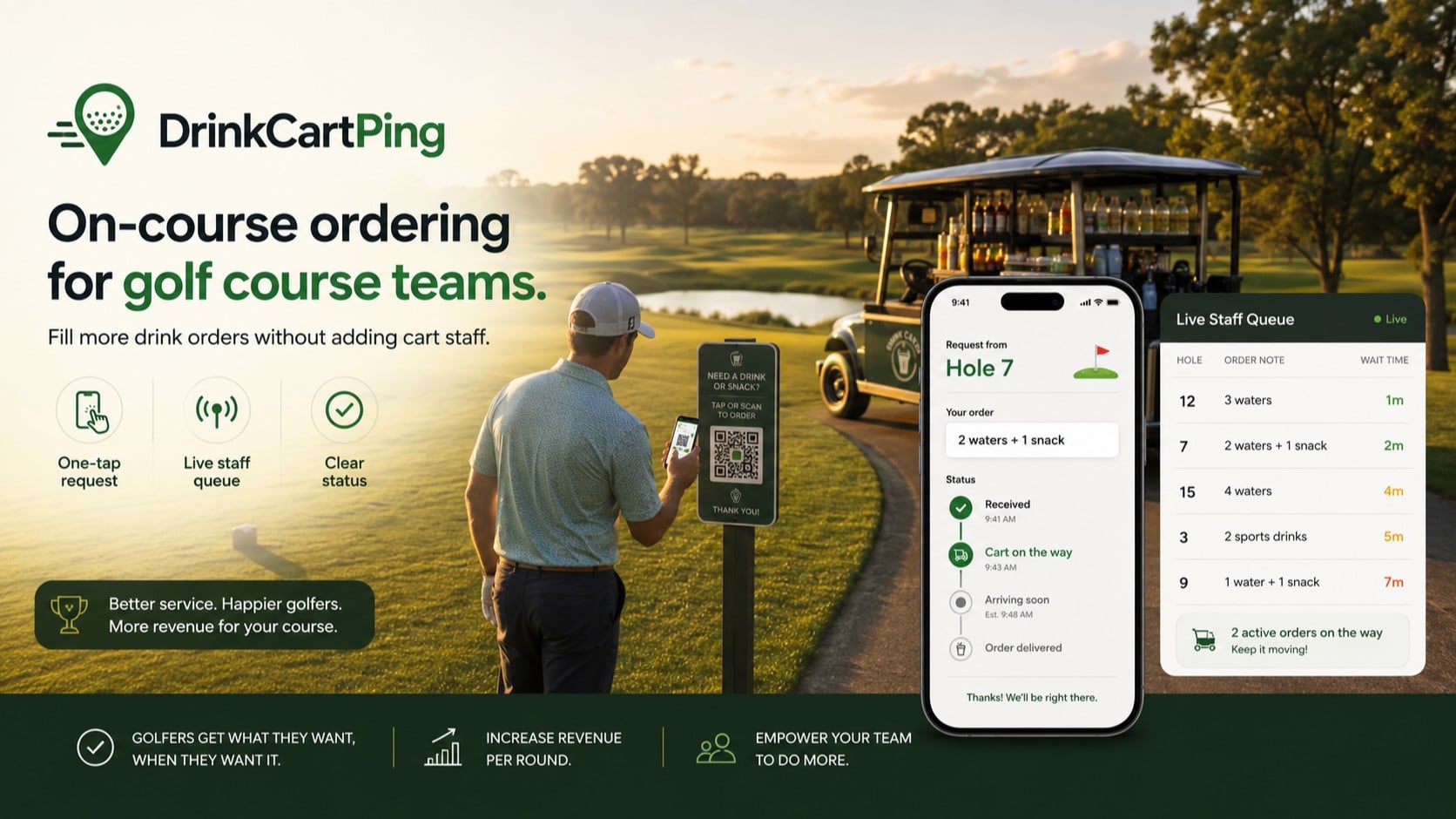
Golfers scan a QR code – placed on tee markers, cart touchpoints, or wherever they already pause – and a hole-specific request link opens in their browser. The hole number is pre-filled. They can add a short note, tap to send, and get back to their round. No app to download, no account to create. The whole interaction takes seconds.
Live Staff Queue, Clear Next Stop
On the operations side, every incoming request lands in a shared live queue visible to clubhouse staff. Each entry shows the hole number, elapsed wait time, and any notes the golfer added. Staff acknowledge the request when the cart is rolling, which immediately updates the golfer’s status. Rather than carts circling on a fixed route hoping to intersect with demand, the team gets a clear next stop based on actual requests – turning reactive cart service into something closer to active dispatch.
Real-Time Status Updates for Golfers
The golfer’s request page updates through three stages: received – cart on the way – delivered. That visibility matters more than it might seem. A golfer who knows the cart is coming doesn’t flag down a passing cart, doesn’t walk to the clubhouse, and doesn’t open their own cooler. The confirmed handoff keeps the transaction alive all the way to fulfillment.
No New Hardware. No Golfer App.
One of the most common reasons courses stall on adopting new technology is implementation friction – new hardware to install, staff to retrain, golfers to onboard. DrinkCartPing sidesteps all of it. Staff work the queue on phones or computers they already use. Golfers tap a browser link. The QR kit is printable and arrives by email after signup.
Setup is same-day. The course keeps its existing cart team and existing rhythm. There’s no new device to manage, no radio protocol to change, and no requirement for golfers to download anything before teeing off. For courses skeptical of golf tech, the barrier to trying it is genuinely low.
Start Capturing Missed Sales This Month
DrinkCartPing offers a 30-day free pilot – no card required – specifically so courses can run the request loop through real rounds before making any billing decision. After the pilot, pricing is straightforward: $19/month or $199/year under a founding-course rate available to the first 50 courses.
For context: if a single round of four golfers each spends $15 more because the cart actually reached them, that’s $60 recovered in one outing. The math on closing even a small slice of missed handoffs each week compounds quickly against a $19/month tool.
The beverage cart isn’t broken. The communication between where golfers are and where the cart goes – that’s the gap. Courses that close it stop leaving money on the fairway.
Affordable Golf Courses covers tools, strategies, and insights to help course operators run smarter, more profitable operations – find more ataffordablegolfcourses.com.
Affordable Golf Courses
8767 3rd Ave
Pleasant Prairie
Wisconsin
53158
United States


