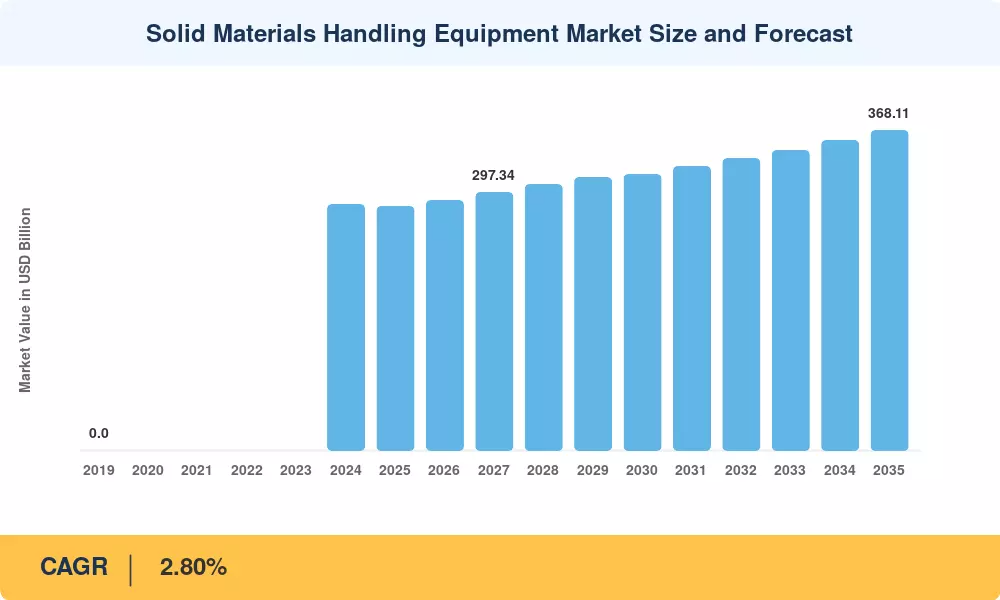
The global solid materials handling equipment market was valued at USD 280.35 billion in 2025 and is projected to reach USD 368.11 billion by 2035
NEW YORK, NY, UNITED STATES, July 27, 2026 /EINPresswire.com/ — The global solid materials handling equipment market was valued at USD 280.35 billion in 2025 and is projected to reach USD 368.11 billion by 2035, registering a CAGR of 2.80% during the forecast period (2026–2035).
Market Overview
Solid materials handling equipment encompasses a broad range of mechanical systems and tools designed for the transportation, storage, control, and protection of materials, goods, and products throughout manufacturing, distribution, and consumption processes . This diverse equipment category includes transport equipment (conveyors, industrial trucks, cranes), handling equipment (dock levelers, hoists), and rack and storage systems (automated storage and retrieval systems, pallet racks) . The market serves critical functions across multiple industries including manufacturing, e-commerce and retail, automotive, food and beverage, pharmaceuticals, construction, and mining, enabling efficient movement of bulk solids, unit loads, and packaged goods.
The market’s steady growth trajectory is underpinned by several powerful catalysts. Sustained e-commerce expansion, which saw online purchases surge during the pandemic and maintain elevated levels, has driven massive investment in warehouse automation and distribution center infrastructure . The rapid adoption of automation technologies, including automated guided vehicles (AGVs), autonomous mobile robots (AMRs), and automated storage and retrieval systems (AS/RS), is transforming material flow across manufacturing and logistics operations . Additionally, the resurgence of manufacturing activity, reshoring initiatives, and industrial fleet replacement cycles in key economies are sustaining capital equipment demand .
Industry trends indicate a decisive shift toward intelligent, connected, and autonomous material handling solutions. The integration of Industry 4.0 technologies—including AI, IoT sensors, and data analytics—is enabling predictive maintenance, real-time tracking, and optimized workflow management . Autonomous mobile robots (AMRs) and automated guided vehicles (AGVs) are rapidly displacing manual material movement in warehouses and factories, driven by labor shortages and the need for 24/7 operational capacity . The adoption of warehouse execution systems (WES) and integration with enterprise resource planning (ERP) platforms is creating unified digital ecosystems that enhance visibility and control across supply chains .
Technological developments are rapidly expanding the market’s capabilities. AI-powered predictive analytics now enable condition-based maintenance that can reduce unplanned downtime by 25–30% through analysis of vibration, temperature, motor current, and acoustic signals to detect early failure modes in bearings, pulleys, gearboxes, and drives . Computer vision systems are being deployed for belt tracking, spillage detection, and safety monitoring, while digital twins allow throughput simulation and optimization without disrupting operations . The emergence of modular, scalable, and digitally connected equipment platforms is enabling faster deployment and easier upgrades .
Policy and regulatory influence on the market is growing, particularly in Europe and North America. The EU’s circular economy and environmental regulations are driving demand for energy-efficient, low-emission equipment, including electric industrial trucks and enclosed conveyor systems . Safety standards including ISO 3691-4:2020 for AGV safety and EN 13262 for machinery compliance are influencing equipment design and procurement specifications . Government initiatives promoting automation, such as Japan’s “Society 5.0” and various smart manufacturing programs, are providing subsidies and incentives for technology adoption .
The demand outlook remains positive, with the market expected to maintain steady growth momentum through 2035. Asia-Pacific was the dominant regional market in 2025, capturing approximately 45.40% of global revenue, driven by China’s vast manufacturing base, expanding logistics infrastructure, and rapid industrialization across India and Southeast Asia . North America and Europe represent mature markets characterized by high automation penetration, significant replacement demand, and strong regulatory drivers for energy efficiency and safety. As digital agriculture, autonomous machinery, and sustainability mandates converge, the market is positioned for sustained expansion across all major regions.
📍 Get Free Sample Report for Detailed Market Insights:
https://www.marketresearchfuture.com/sample_request/68393
Market Segmentation
By Product Type
The solid materials handling equipment market is segmented by product type into Transport Equipment (conveyors, industrial trucks, cranes, hoppers, reclaimers), Handling Equipment (dock levelers, hoists, lift/tilt/turn tables, parts feeders, balancers), Rack & Storage Equipment (AS/RS, selective pallet racks, sliding racks, stacking frames, push-back racks), and Others (unit load formation equipment, control equipment, identification devices) . Transport equipment represents the largest and fastest-growing segment, driven by increasing material movement requirements across expanding logistics networks . Automated storage and retrieval systems (AS/RS) are projected to account for an estimated 28.4% of the product segment by 2035, driven by the need for high-density storage, inventory accuracy, and reduced labor dependency in e-commerce fulfillment centers .
By Application/End-Use Industry
Application segmentation covers E-commerce & Retail, Manufacturing (Durable Goods, Food & Beverage), Warehousing & Logistics, Construction, Mining, Aerospace & Defense, and Others. The construction industry is experiencing the highest CAGR, driven by substantial global infrastructure development, government investments in logistics parks, ports, airports, and manufacturing facilities that require efficient material movement systems . The e-commerce and retail segment is rapidly expanding as online purchasing growth necessitates high-speed sorting systems, robotics, and scalable fulfillment infrastructure to meet real-time order processing demands . Automotive and consumer electronics sectors continue to rely on sophisticated materials handling for lean manufacturing and just-in-time assembly processes .
By Equipment Type
Additional segmentation includes Conveyors, Cranes, Industrial Trucks, Automated Guided Vehicles (AGVs), and Others (hoppers, reclaimers, stackers) . Conveyor systems serve as the backbone of parcel and sortation systems in large distribution centers, valued for their scalability and reliability in high-volume continuous operation . AGVs and industrial robots are the fastest-growing equipment types, with AGVs projected to grow at approximately 7.8% CAGR, driven by round-the-clock warehouse operations, significant labor cost reduction, and improved safety and precision in material transport . Industrial robots, growing at 7.5% CAGR, serve high-speed palletizing and depalletizing applications, providing consistency in repetitive tasks .
By Region
Regional segmentation includes North America, Europe, Asia Pacific, South America, and the Middle East and Africa. Asia Pacific was the dominant region in 2025 with approximately 45.40% share, supported by China’s manufacturing dominance and India’s expanding infrastructure . North America is the second-largest market, characterized by high technology adoption, significant replacement demand, and strong warehouse automation investment . Europe is driven by modernization, energy efficiency regulations, and circular economy initiatives .
🛒 You can buy this market report at:
https://www.marketresearchfuture.com/checkout?currency=one_user-USD&report_id=68393
Regional Analysis
Asia-Pacific
Asia-Pacific dominated the global solid materials handling equipment market in 2025 with approximately 45.40% revenue share, driven by China’s vast manufacturing base, expanding logistics infrastructure, and rapid industrialization across India and Southeast Asia . China remains the largest single national market, supported by government infrastructure spending, the “New Energy Vehicle Industrial Development Plan,” and massive e-commerce growth. India represents the fastest-growing major market, driven by the government’s focus on infrastructure development, manufacturing initiatives like “Make in India,” and the rapid expansion of the logistics sector . Japan is a key market for advanced automation technologies, with an aging workforce and government-led “Society 5.0” initiatives driving adoption of AGVs, AS/RS, and robotics . Southeast Asian countries including Indonesia, Vietnam, Thailand, and Malaysia are experiencing increased port expansion, manufacturing investment, and urban development, supporting demand for durable equipment suited to humid, high-throughput environments .
North America
North America is the second-largest regional market, characterized by high technology adoption, significant replacement demand, and strong warehouse automation investment. The United States accounts for the majority of regional revenue, driven by e-commerce growth, reshoring initiatives, and the Inflation Reduction Act’s incentives for clean-energy manufacturing. The U.S. Department of Energy’s Industrial Efficiency Initiative is accelerating replacement cycles for older, less efficient handling equipment . Canada’s market is supported by the federal ZEV mandate and cross-border logistics integration with the US. Mexico benefits from nearshoring trends, with US manufacturing relocating to Mexico driving demand for handling equipment in automotive, electronics, and aerospace sectors .
Europe
Europe is a mature and sophisticated market, driven by modernization, energy efficiency regulations, and circular economy initiatives. The region’s strict environmental, machinery safety, and occupational standards are pushing customers to evaluate conveyors and material handling systems on total cost of ownership, fugitive dust reduction, energy intensity, and maintainability . Germany leads regional demand, supported by its strong industrial base, automotive sector, and advanced logistics infrastructure. France and the United Kingdom are significant markets, with government support for sustainable manufacturing and logistics modernization . Eastern European countries are growing steadily as manufacturing hubs attract investment in automation technologies.
Rest of the World
The Rest of the World segment, encompassing South America and the Middle East and Africa, presents developing market opportunities. Latin America, particularly Brazil and Mexico, is experiencing growth driven by mining, agriculture (soy, sugar), and infrastructure investment . Brazil’s iron ore and soybean exports support demand for ruggedized, corrosion-resistant systems suited to remote mines and export corridors . The Middle East, led by Saudi Arabia and the UAE, is expanding bulk handling demand through mining diversification, phosphate, aluminum, cement, industrial zones, and port logistics, where dust control and heat-resistant components are critical . Africa’s outlook is tied to minerals, cement, grain storage, fertilizer distribution, and export corridors, with reliability, ease of maintenance, and spare parts availability often more important than advanced complexity in remote operations .
Competitive Landscape / Key Players
The global solid materials handling equipment market is characterized by the presence of numerous global and regional players competing on technology innovation, product quality, and service capabilities. Key companies operating in this market include BEUMER GROUP, Daifuku Co., Ltd., Honeywell International Inc., KION GROUP AG, Mecalux, S.A., Murata Manufacturing Co., Ltd., SSI SCHAEFER, Swisslog Holding AG, Toyota Industries Corporation, and Vanderlande Industries B.V. .
Strategic developments in the market include significant product launches and technology partnerships. In February 2024, Bobcat announced a fully rebranded materials handling product lineup featuring forklifts and warehouse equipment under the integration of Doosan Industrial Vehicles (DIV) at LogiMAT 2024 . In September 2023, Yale Lift Truck Technologies launched a new Outdoor Reach Truck that applies smart design to meet the operational needs of logistics businesses . In May 2023, Toyota Material Handling (TMH) announced the launch of three new electric forklift models to its industry-leading lineup of material handling products and solutions .
Competitive differentiation increasingly hinges on digital integration, automation capabilities, energy efficiency, and aftermarket service networks. Leading OEMs are leveraging technology partnerships and data platforms as differentiation levers, with ecosystem breadth and data-platform capabilities increasingly influencing purchasing decisions among large enterprises. The competitive landscape is expected to consolidate moderately through 2035 as leading players pursue platform standardization and integrated digital ecosystems that increase customer switching costs.
Latest Industry News & Developments
Recent industry developments highlight the ongoing transformation of the solid materials handling equipment market toward automation, electrification, and digital integration. In February 2024, Bobcat announced a fully rebranded materials handling product lineup featuring forklifts and warehouse equipment under the integration of Doosan Industrial Vehicles (DIV) at LogiMAT 2024, demonstrating the trend toward unified, comprehensive product portfolios .
In September 2023, Yale Lift Truck Technologies launched a new Outdoor Reach Truck that applies smart design to meet the operational needs of logistics businesses, reflecting the industry’s focus on specialized, application-specific solutions . In May 2023, Toyota Material Handling (TMH) announced the launch of three new electric forklift models, continuing the shift toward electrification and lithium-ion battery technology in the industrial truck segment .
Industry leaders are increasingly prioritizing engineered value over equipment-only sales, quantifying throughput, availability, dust reduction, energy use, maintenance savings, safety performance, and regulatory compliance . Retrofit packages for transfer points, belt cleaners, drives, and monitoring sensors are unlocking faster customer ROI than full system replacement, especially at brownfield mines, cement plants, ports, and grain terminals .
Market Challenges & Opportunities
Key restraints facing the solid materials handling equipment market include the high initial capital investment required for advanced automation systems, which can be prohibitive for small and medium enterprises, particularly in developing regions. The complexity of integrating new handling equipment with existing infrastructure and legacy systems presents significant technical challenges, requiring specialized expertise and often resulting in extended implementation timelines and cost overruns. Fluctuating raw material prices for steel and electronic components exert persistent margin pressure on manufacturers . Skilled labor shortages for designing, installing, and maintaining advanced material handling systems, including robotics and AI-driven platforms, further constrain adoption in many regions .
Emerging opportunities in the market are substantial and diverse. The integration of AI and IoT-enabled predictive maintenance platforms represents a significant opportunity, with AI models reducing unplanned downtime by 25–30% through early detection of failure modes in bearings, pulleys, and gearboxes . The rapid growth of e-commerce and omnichannel retail is driving demand for high-speed sortation systems, robotic picking and packing, and scalable fulfillment infrastructure . The adoption of automated storage and retrieval systems (AS/RS) for high-density storage in urban logistics hubs is accelerating, with AS/RS expected to account for 28.4% of the product segment by 2035 .
Future potential lies in the development of autonomous mobile robots (AMRs) for flexible, human-collaborative material movement, with AMR adoption growing at rates exceeding 7.8% CAGR as facilities seek to optimize labor allocation and 24/7 operational capacity . The convergence of materials handling with digital twin technology will enable real-time simulation, predictive optimization, and condition-based maintenance, fundamentally changing how systems are designed, deployed, and operated . Sustainability pressures will accelerate the shift to electric, energy-efficient equipment and closed-loop material flow systems, with manufacturers that demonstrate measurable lifecycle performance and reduced environmental impact gaining a competitive advantage .
To explore more market insights, visit us at:
https://www.marketresearchfuture.com/reports/solid-materials-handling-equipment-market-68393
Final Market Summary
The solid materials handling equipment market is positioned for steady growth through 2035, driven by e-commerce expansion, automation adoption, manufacturing resurgence, and infrastructure investment. The projected valuation of USD 368.11 billion reflects sustained demand across transport, handling, and storage equipment, with the market transitioning from conventional systems to intelligent, connected, and autonomous solutions.
The medium-term growth outlook remains positive, with the market registering a CAGR of 2.80% during the forecast period. Asia-Pacific will continue to lead market expansion through China’s manufacturing scale and India’s infrastructure development, while North America and Europe maintain significant positions through technology leadership and regulatory-driven modernization. The ongoing development of AI-powered analytics, autonomous mobile robots, and digital twin platforms will continue to expand market possibilities and applications.
Long-term industry potential extends beyond the current forecast horizon. The integration of artificial intelligence and machine learning will transform reactive maintenance into predictive, condition-based operations, with AI models enabling higher availability, improved energy efficiency, and safer operations . The shift toward modular, scalable, and digitally connected equipment will accelerate, with variable-speed drives, enclosed conveyors, and engineered transfer points becoming differentiators .
More Related Reports from MRFR Library:
Wire And Cable Market: https://www.marketresearchfuture.com/reports/wire-and-cable-market-25173
Recycling Equipment Machinery Market: https://www.marketresearchfuture.com/reports/recycling-equipment-machinery-market-25176
Industrial Bearings Market: https://www.marketresearchfuture.com/reports/industrial-bearings-market-25273
Roller Shutter Market: https://www.marketresearchfuture.com/reports/roller-shutter-market-25284
Concrete Pumps Market: https://www.marketresearchfuture.com/reports/concrete-pumps-market-25304
Pipeline Strainer Market: https://www.marketresearchfuture.com/reports/pipeline-strainer-market-25317
Hvac Filters Market: https://www.marketresearchfuture.com/reports/hvac-filters-market-25430
Soft Gel Encapsulation Machine Market: https://www.marketresearchfuture.com/reports/soft-gel-encapsulation-machine-market-25474
Mechanical Seals Market: https://www.marketresearchfuture.com/reports/mechanical-seals-market-25629
Forestry Equipment Market: https://www.marketresearchfuture.com/reports/forestry-equipment-market-26097
Larry Wilson
WantStats Research And Media Pvt. Ltd.
+1 855-661-4441
email us here
Legal Disclaimer:
EIN Presswire provides this news content “as is” without warranty of any kind. We do not accept any responsibility or liability
for the accuracy, content, images, videos, licenses, completeness, legality, or reliability of the information contained in this
article. If you have any complaints or copyright issues related to this article, kindly contact the author above.

Media gallery