
Glass now plays a central role in commercial buildings, from shop fronts and entry doors to office partitions and balustrades. SOS Glass Services, a Bexley glazing company, describes architectural glass as one of the most common and highly specified building materials, used both inside and outside commercial properties. With so many applications, choosing between toughened and laminated glass is one of the first decisions a business owner faces when fitting out or upgrading premises. Both are safety glass, but they behave very differently under stress and when they break.
How Toughened Glass Is Made and How It Breaks
Toughened glass, also called tempered glass, is produced by heating standard glass to more than 600°C and then rapidly cooling its surfaces with jets of air. This process puts the outer surfaces into compression, making the glass around four to five times stronger than ordinary annealed glass of the same thickness.
When toughened glass does break, it shatters into small, relatively blunt fragments rather than long, sharp shards. This reduces the risk of serious cuts, which is why it is widely used in areas with heavy foot traffic. However, the whole panel breaks at once, leaving an open gap until it is replaced.
Toughened glass also cannot be cut, drilled, or edged after treatment. Every panel must be made to its final size before toughening, which can affect how quickly a broken panel is replaced.
How Laminated Glass Is Made and How It Breaks
Laminated glass consists of two or more sheets of glass bonded together with a plastic interlayer, most commonly polyvinyl butyral (PVB). If the glass cracks, the fragments stick to the interlayer, and the panel generally stays in its frame.
This behaviour gives laminated glass several advantages. It resists forced entry, because an intruder must break through both the glass and the interlayer. It also reduces noise transfer, and a standard PVB interlayer blocks most ultraviolet light, helping to limit fading of stock, furniture and flooring near windows.
Laminated glass made from standard annealed sheets is not significantly stronger than ordinary glass of the same thickness, but it can often be cut to size, which can make replacement simpler.
What Australian Standards Require
Both toughened and laminated glass can be classified as Grade A safety glass under AS/NZS 2208. AS 1288, the Australian Standard for glass in buildings, sets out where safety glass must be used, including doors, side panels next to doors and low-level glazing where people could accidentally walk into it. Some applications, such as overhead glazing and certain balustrade designs, have additional requirements, so the right choice depends on how and where the glass is installed.
Comparing the Two for Commercial Use
Toughened glass suits frameless glass doors, shower screens in staff amenities, and partitions where strength and impact resistance matter most. It is generally less expensive than laminated glass of a similar specification.
Laminated glass suits shop fronts and street-facing windows, where security and keeping the panel in place after damage are priorities. It is also useful for meeting room partitions, where the interlayer helps reduce sound passing between spaces.
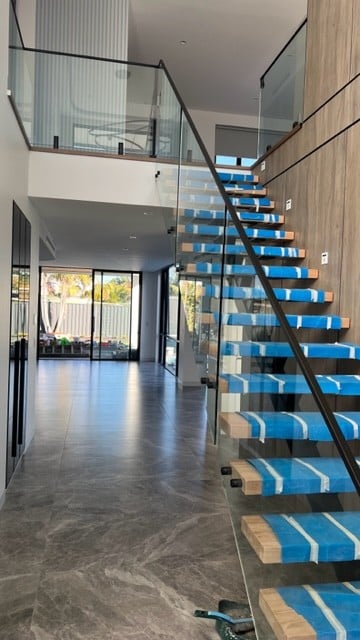
For applications that need both strength and post-breakage retention, toughened laminated glass combines the two. It is commonly specified for frameless balustrades on balconies, stairs and terraces, as well as for overhead glazing.
Matching the Glass to Each Part of the Premises
Most commercial properties use more than one type of glass. A retail tenancy might use laminated glass in the shop front for security, toughened glass in a frameless entry door for strength, and toughened laminated glass on a mezzanine balustrade. An office fit-out might combine toughened partitions in open areas with laminated panels around meeting rooms.
Before deciding, it helps to weigh security risks, foot traffic, noise, UV exposure, budget, and how quickly a damaged panel would need replacing. A licensed glazier can assess these factors against AS 1288 and recommend a suitable specification for each location. Business owners who want to explore their options further can visit the SOS Glass Services website for more information on commercial glazing.
SOS Glass Services Pty Ltd
34 Verdun Street
Bexley
NSW
2207
Australia


