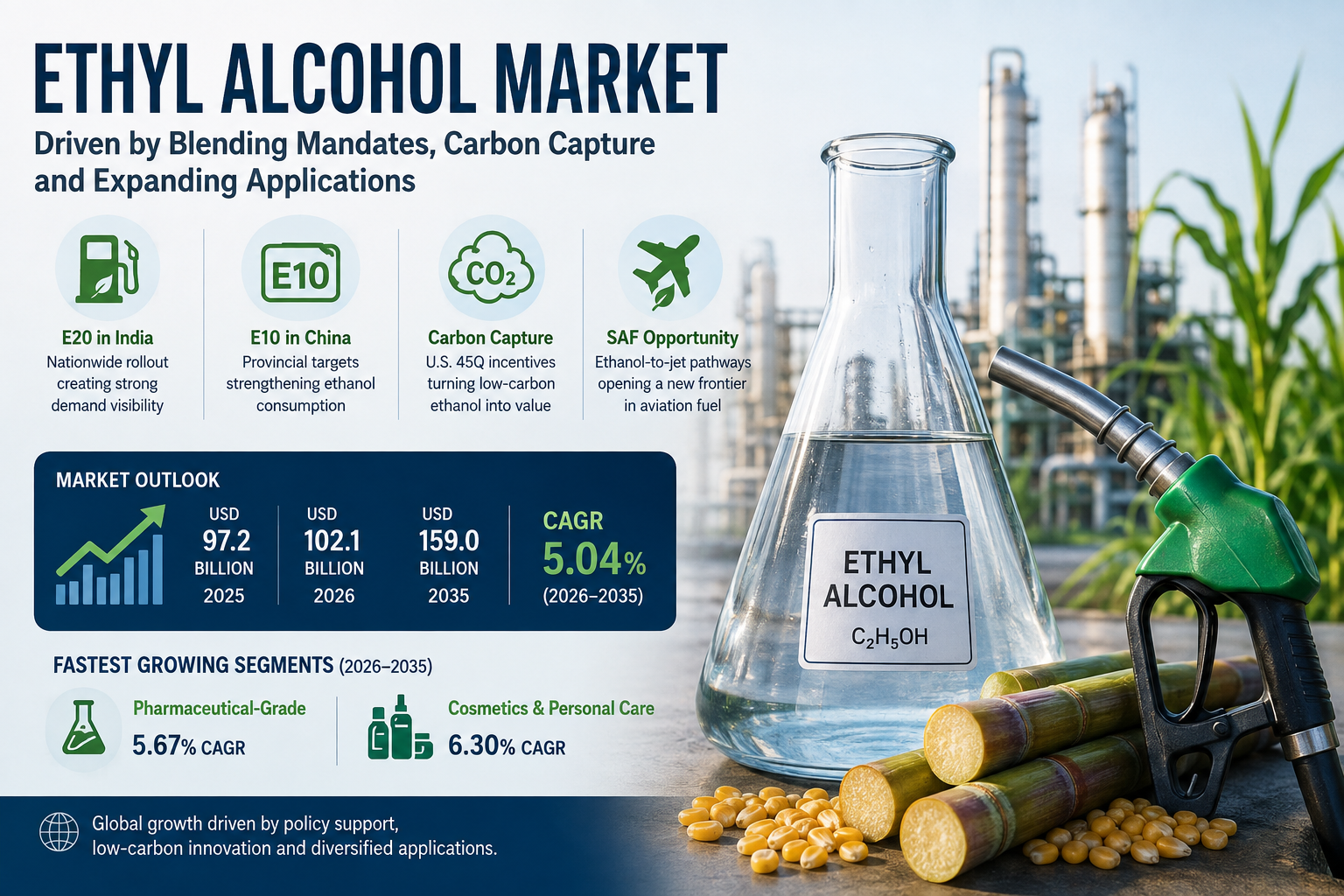
India’s E20 rollout, China’s E10 expansion and U.S. carbon-capture incentives are reshaping global ethanol demand and investment.
NEW YORK, NY, UNITED STATES, August 26, 2026 /EINPresswire.com/ — The global ethyl alcohol market is entering a period of structural transformation as government-led fuel-blending programs, carbon-reduction incentives and emerging high-value applications reshape demand across major producing and consuming regions. According to Market Research Future, the global ethyl alcohol market was valued at USD 97.2 billion in 2025 and is projected to grow from USD 102.1 billion in 2026 to USD 159.0 billion by 2035, representing a 5.04% compound annual growth rate (CAGR) during the 2026–2035 forecast period.
The market’s next phase is increasingly being defined by two forces operating simultaneously: the expansion of ethanol blending mandates across major Asian markets and the growing economics of low-carbon ethanol production in North America. India’s nationwide E20 rollout and China’s provincial E10 initiatives are creating additional structural demand for fuel ethanol, while carbon-capture incentives in the United States are encouraging producers to explore new revenue opportunities associated with lower-carbon ethanol.
Beyond conventional transportation fuel applications, ethanol is also finding growth opportunities in sustainable aviation fuel (SAF), pharmaceuticals, cosmetics and personal care, industrial solvents and advanced biofuel pathways. This diversification is becoming increasingly important as electric-vehicle adoption gradually places a ceiling on long-term gasoline consumption in mature automotive markets.
According to the report, fuel-grade ethanol accounted for 63.4% of global market volume in 2025, demonstrating the continued importance of blending mandates to industry economics. At the same time, pharmaceutical-grade ethanol is projected to be the fastest-growing grade category, advancing at a 5.67% CAGR through 2035. Cosmetics and personal care is identified as the fastest-growing end-user segment, with a projected 6.30% CAGR during the forecast period.
Get Full PDF Sample Copy of Report: (Including Full TOC, List of Tables & Figures, Chart) @ https://www.marketresearchfuture.com/sample_request/23343
Policy-Led Blending Programs Create a New Demand Floor
Government blending mandates remain one of the most powerful structural drivers of the global ethyl alcohol industry.
India is emerging as one of the most significant growth markets as the country’s ethanol-blending program continues to expand. The report identifies India’s E20 rollout as a major contributor to Asia-Pacific’s growth trajectory. The report estimates that India could register approximately 7.2% CAGR through 2035, supported by the continued expansion of ethanol production and blending infrastructure.
The expansion of blending is creating demand visibility for distillers, feedstock suppliers, logistics operators and downstream fuel companies. It is also encouraging investment in grain-based and molasses-based distilleries, while strengthening the strategic importance of domestic ethanol production.
China is also contributing to regional momentum through provincial E10 initiatives. The report notes that provincial E10 mandates have returned to focus in parts of northeastern China, creating an additional demand catalyst for ethanol producers and suppliers.
Across Asia-Pacific, these policy initiatives are contributing to the region’s position as the fastest-growing geographic market. The report forecasts a 6.97% CAGR for Asia-Pacific between 2026 and 2035, ahead of other major regions.
The broader significance extends beyond individual mandates. As governments seek to reduce the carbon intensity of transportation fuels while maintaining existing vehicle fleets, ethanol offers a commercially established blending pathway that can be deployed without requiring the complete replacement of internal-combustion infrastructure.
Carbon Capture Opens a New Revenue Model for Ethanol Producers
The economics of ethanol production are also being influenced by the growing importance of carbon intensity.
In the United States, Section 45Q carbon-capture incentives are encouraging ethanol producers to examine carbon capture, utilization and storage (CCUS) as a pathway to reduce emissions while potentially creating additional value from captured carbon.
The report estimates that carbon capture and 45Q credit stacking could contribute approximately 0.9 percentage points of impact to market CAGR, highlighting the increasing strategic importance of low-carbon production.
For producers, the opportunity extends beyond simply manufacturing ethanol. A facility capable of reducing the carbon intensity associated with its ethanol output can potentially access additional environmental-credit and premium-market opportunities, depending on applicable regulations, verification requirements and commercial structures.
This is particularly relevant for aging and established Midwest distilleries. Rather than viewing existing facilities solely as commodity ethanol assets, producers are increasingly evaluating how carbon capture, improved energy efficiency and renewable-energy integration can reposition them as lower-carbon industrial platforms.
The development of CO₂ transportation and sequestration infrastructure is therefore becoming strategically important. The report cites Midwest carbon-capture infrastructure development as a pathway for ethanol plants to participate in carbon-management systems and capture associated economic value.
The result could be an increasingly differentiated market in which ethanol is valued not only according to volume, purity and feedstock, but also according to its verified carbon intensity.
Sustainable Aviation Fuel Creates a Second Growth Engine
While road transportation remains the largest application for ethanol, the emergence of ethanol-to-jet technologies could provide producers with a significant diversification opportunity.
Alcohol-to-jet (ATJ) pathways enable ethanol to serve as a feedstock for sustainable aviation fuel, potentially connecting the established ethanol production industry with the rapidly developing aviation decarbonization market.
The report identifies SAF pathway commercialization as an important medium-term market driver and notes that announced global ATJ capacity commitments have expanded substantially. The report also highlights commercial-scale ethanol-to-SAF production as evidence that ethanol can increasingly participate in aviation fuel supply chains.
This development could become particularly important as electric propulsion remains difficult to deploy across long-haul aviation. Airlines and fuel producers are therefore evaluating SAF as one of the primary near- and medium-term pathways for reducing aviation-sector emissions.
For ethanol producers, SAF creates the potential to diversify away from exclusive dependence on gasoline blending. It also creates an opportunity to compete in higher-value fuel markets where sustainability credentials, feedstock traceability and carbon intensity can influence purchasing decisions.
Pharmaceutical-Grade Ethanol Gains Momentum
The ethyl alcohol market is also expanding beyond fuel applications.
Pharmaceutical-grade ethanol is projected to grow at a 5.67% CAGR through 2035, making it the fastest-growing grade category in the report. Demand is being supported by pharmaceutical manufacturing, active pharmaceutical ingredient (API) production, excipient applications and other high-purity uses.
The continued expansion of pharmaceutical manufacturing capacity across India, China, Southeast Asia and other emerging production hubs is creating opportunities for high-purity ethanol suppliers.
Unlike commodity fuel ethanol, pharmaceutical-grade ethanol competes on purity, consistency, quality assurance, regulatory compliance and supply reliability. This gives producers opportunities to move into specialized markets where product specifications and certification can support stronger value capture.
The growth of biologics, pharmaceutical formulations and geographically diversified API supply chains could further strengthen demand for high-purity ethanol during the forecast period.
Cosmetics and Personal Care Add a High-Growth Application
Cosmetics and personal care represent another important area of market diversification.
The report forecasts a 6.30% CAGR for cosmetics and personal care applications between 2026 and 2035, the highest growth rate among the report’s end-user categories.
Ethanol is widely used as a solvent and formulation component across fragrances, skincare, haircare and other personal-care products. Growing consumer interest in ingredient transparency and clean-label formulations is encouraging manufacturers to reconsider sourcing, formulation and sustainability characteristics.
For producers, this creates an opportunity to develop specialized ethanol grades designed for premium personal-care applications. Low-carbon production, traceability and verified environmental attributes could increasingly become differentiators as global brands evaluate emissions throughout their supply chains.
The development of higher-value personal-care applications demonstrates the broader evolution of the ethyl alcohol industry from a predominantly commodity-oriented market toward a portfolio encompassing fuel, pharmaceutical, cosmetic, industrial and emerging aviation applications.
Asia-Pacific Emerges as a Critical Growth Region
Asia-Pacific is expected to remain at the center of global ethyl alcohol market expansion through 2035.
The report projects the region to grow at 6.97% CAGR, supported by fuel-blending mandates, expanding industrial production, pharmaceutical manufacturing and increasing ethanol production capacity.
India stands out because of its E20 policy trajectory and rapidly expanding distillation infrastructure. China remains strategically important due to its large industrial base and provincial blending programs. Japan and South Korea contribute through established industrial and fuel markets, while Southeast Asian countries offer additional opportunities through developing biofuel programs.
The region’s growth is also supported by the availability of diverse feedstocks, including sugarcane, molasses, grains and other agricultural resources.
As governments across emerging economies seek to balance energy security, domestic agricultural development and emissions reduction, locally produced ethanol can serve several policy objectives simultaneously.
North America Maintains a Strong Production Position
North America remained the largest regional market in 2025, accounting for approximately 35.7% of global market share, according to the report. The region’s position is anchored by the scale of the U.S. corn-ethanol industry and the established infrastructure supporting ethanol production, blending and distribution.
The strategic challenge for North American producers is increasingly about maximizing the value of existing production rather than simply increasing commodity volumes.
Electric-vehicle adoption could moderate long-term gasoline demand and, consequently, constrain conventional fuel-ethanol growth. The report therefore identifies carbon capture, SAF, specialty grades and advanced ethanol technologies as important avenues for producers seeking to maintain growth.
Carbon-intensity management could become particularly influential as buyers, regulators and downstream businesses place greater emphasis on emissions associated with fuel and chemical supply chains.
Cellulosic Ethanol Represents a Longer-Term Technology Opportunity
Feedstock diversification is another important theme shaping the industry.
Corn-based ethanol remains dominant in North America, while sugarcane-based ethanol has a particularly strong position in Brazil and other tropical agricultural markets. However, cellulosic ethanol is projected to be the fastest-growing source category, with the report forecasting a 7.8% CAGR between 2026 and 2035.
Cellulosic production can use agricultural residues, crop waste and other non-food biomass, potentially expanding the feedstock base while improving resource efficiency.
Although commercial-scale cellulosic ethanol continues to face technological and economic challenges, advances in enzymes, fermentation systems and biomass processing are supporting continued investment.
The successful commercialization of second-generation ethanol could eventually broaden the industry’s addressable feedstock base and strengthen its role within the circular bioeconomy.
Market Challenges Remain
Despite its positive long-term outlook, the global ethyl alcohol market faces several constraints.
The first is the gradual electrification of road transportation. As electric vehicles capture a larger portion of new vehicle sales, gasoline consumption may eventually decline in mature markets, placing pressure on conventional fuel ethanol demand.
Feedstock volatility is another challenge. Corn, sugarcane, molasses and other agricultural inputs are exposed to weather conditions, crop yields, commodity prices and competing uses.
Water availability and production efficiency are also becoming increasingly important, particularly in regions where distilleries compete with agriculture and other industrial users for water resources.
Regulatory fragmentation adds another layer of complexity. Ethanol producers must navigate different fuel standards, sustainability requirements, trade policies, certification systems and carbon-accounting frameworks across markets.
These challenges are encouraging leading companies to focus on operational efficiency, feedstock flexibility, technology deployment and product diversification.
Competitive Landscape
The global ethyl alcohol market remains relatively fragmented, with regional feedstock economics playing a significant role in determining production competitiveness.
Companies profiled in the report include POET, Raízen, ADM, COFCO, Cargill, Green Plains, Valero Energy, Flint Hills Resources, Tereos and Wilmar International.
Competition increasingly extends beyond production capacity. Producers are investing in carbon-management technologies, advanced ethanol pathways, higher-purity products, feedstock integration, digital process optimization and downstream partnerships.
Vertically integrated business models can provide advantages by linking feedstock procurement, ethanol production, co-products, logistics and environmental attributes.
At the same time, technology providers and infrastructure developers are becoming increasingly important participants in the value chain as producers adopt carbon capture, digital fermentation monitoring and SAF conversion technologies.
The Road Ahead: From Commodity Ethanol to Strategic Low-Carbon Molecule
The global ethyl alcohol market is entering a new phase in which volume growth and value-added applications are developing simultaneously.
The projected expansion from USD 97.2 billion in 2025 to USD 159.0 billion by 2035 represents a significant increase in market value, but the underlying story is broader than market size alone.
Ethanol is increasingly being positioned as a versatile platform molecule with applications spanning transportation fuels, aviation, pharmaceuticals, cosmetics, food and beverage, industrial solvents and advanced biofuels.
In Asia, blending mandates are creating new baseline demand. In North America, carbon capture is creating opportunities to reduce emissions and monetize environmental attributes. In Europe, sustainability requirements are encouraging advanced biofuel pathways. Globally, SAF is opening a potential new outlet for ethanol production.
The combination of policy support, technological innovation and application diversification is therefore expected to keep the industry relevant even as the transportation energy landscape evolves.
Companies capable of combining reliable production with low-carbon technologies, flexible feedstock strategies, high-purity products and diversified downstream markets are likely to be best positioned to capture the next phase of growth.
With the global ethyl alcohol market forecast to reach USD 159.0 billion by 2035 at a 5.04% CAGR, ethanol’s future is increasingly being defined not simply by how much is produced, but by where it is used, how efficiently it is produced and how much carbon is associated with every unit sold.
Discover Related Research Reports By Market Research Future:
Molasses Market
https://www.marketresearchfuture.com/reports/molasses-market-7007
Sugarcane Bottle Market
https://www.marketresearchfuture.com/reports/sugarcane-bottle-market-29688
Sugarcane Harvester Market
https://www.marketresearchfuture.com/reports/sugarcane-harvester-market-23382
Market Research Future
Market Research Future
+1 855-661-4441
email us here
Legal Disclaimer:
EIN Presswire provides this news content “as is” without warranty of any kind. We do not accept any responsibility or liability
for the accuracy, content, images, videos, licenses, completeness, legality, or reliability of the information contained in this
article. If you have any complaints or copyright issues related to this article, kindly contact the author above.

Media gallery